Listen To My Latest Podcast Episode:

149: A 3-Question Practice To End Overthinking and Move Forward

Listen To My Latest Podcast Episode:149: A 3-Question Practice To End Overthinking and Move Forward

  • About
    • My Journey
  • Work With Me
    • 1 on 1 Coaching
    • Inside Out Method
  • Testimonials
  • Podcast
    • Media
  • Blog
  • Giving Back
  • Contact
  • Search
  • Menu Menu
  • LinkedIn

Tag Archive for: leadership

The Gifts I Found Walking the Inca Trail

 

Last week, I fulfilled a 25-year dream — walking the four-day Inca Trail to Machu Picchu.

But the first gift of the journey came before I ever left home.

The day before my flight, I was teaching an online class when I admitted to my group that I was worried — not about the altitude, the rain, or the tents (though all would prove memorable) — but about whether I could physically handle the trek.

I hadn’t prepared the way I “should have.” I’d done my normal workouts, but not the kind of conditioning a 26-mile climb through the Andes really asks of you.

The self-criticism started early: You should’ve trained more. You’re not ready. You’re going to fail.

And that’s when I caught it.

It wasn’t the fear of failing the trail that had me clenched — it was the fear of how I would treat myself if I did.

So I made a quiet agreement with myself:

If I need to rest, I’ll be kind.

If I fall behind, I’ll be kind.

If I don’t “perform,” I’ll still be kind.

Eureka. The terror eased.

Sometimes what we’re most afraid of isn’t what might happen — it’s how we’ll respond to ourselves if it does.

And that is something fully within our control.

Lesson #1: The View from the Back Is Beautiful

Our guide — whom we nicknamed “Mr. Miyagi” — had led the Inca Trail 643 times.

He was small in stature, big in wisdom, and moved with a rhythmic grace, trekking poles in hand, like a meditation in motion.

His only rule: Never let yourself get out of breath or overextended.

“Stay your pace,” he said.

We did. Slow, deliberate, steady — “wax on, wax off.”

Dozens of trekkers sped by us that first day.

But hours later, we’d pass them again — exhausted, red-faced, gasping for air.

The tortoise and the hare came to life on those ancient stones.

For the first time in a long while, I saw the gift of the slower lane.

I wasn’t missing out by not “rushing” or “winning.”

The view from behind was stunning.

Life isn’t a race to be won.

She who wins is the one who enjoys it the most.

Lesson #2: Live in Ayni — “Today for You, Tomorrow for Me.”

The Quechua people of the Andes live by a philosophy called Ayni — sacred reciprocity.

If your neighbor needs help building a home, you help. No payment, no tally. Just:

“Today for you, tomorrow for me.”

It’s not transactional; it’s relational.

And it reminded me that true leadership — and true wealth — are built in community, not independence.

Lesson #3: Trust the Moment You’re In

By day two, I caught myself asking our guide,

“What’s coming tomorrow?”

“When will we see a bathroom again?”

Reasonable questions — but behind them was a habit of control.

I realized I’d been living like this for years — forecasting, future-tripping, bracing.

By day three, I decided to practice something new.

I’d trust myself to handle whatever came when it came.

No more pre-solving problems that didn’t exist yet.

When you learn to be with the unknown, calm enters.

Self-trust builds.

Worry doesn’t prevent pain — it only prevents peace.

And the more you teach yourself presence, little by little, you stay there.

Lesson #4: One Step at a Time Is Always Enough

At times, the trail felt endless — steep stone stairs that seemed to touch the sky.

When I looked too far ahead, it felt impossible.

So I practiced something simple:

Don’t look at the mountain. Look at your next step.

Over and over again, that was enough.

It turns out, it always is.

Lesson #5: Connect with Something Larger

By day three, the mountains themselves seemed to hum.

Energy, Source, Nature, God — whatever you call it — was palpable.

I found myself in tears more than once, moved by the sacredness of it all.

There’s something about walking 26 miles through the clouds that resets your nervous system.

It strips away the noise, the striving, the illusion of control — until what’s left is simply you and Life itself.

When you allow yourself to slow down, to trust, to be present, you begin to feel more connected — to nature, to others, and perhaps most importantly to yourself.

When I returned home, my husband took one look at me and said,

“You’ve changed.”

He didn’t need to say how.

I knew.

The Inca Trail gave me many gifts.

But the greatest was remembering what’s always been true:

Life isn’t about racing to the top.

It’s about being present for the climb.

Everything’s going to be ok.

You’re already on sacred ground.

Your Invitation to Reflect

Where in your life might you be rushing to the top — missing the view from where you are?

What would shift if you treated yourself with kindness, no matter the outcome?

Could you trust that one step at a time really is enough?

Because maybe, just maybe…

The point was never to complete or “win” the trail —

But to walk it with your whole heart.

With warmth and wonder,

~Rita

https://www.ritahyland.com/wp-content/uploads/2025/11/inca_trail.png 1200 1200 Joyce Polintan https://www.ritahyland.com/wp-content/uploads/2020/04/Rita-Hyland-1-line-blue-NOTAG-01.svg Joyce Polintan2025-11-11 14:20:482025-11-11 14:21:29The Gifts I Found Walking the Inca Trail
Shifting perspective for growth

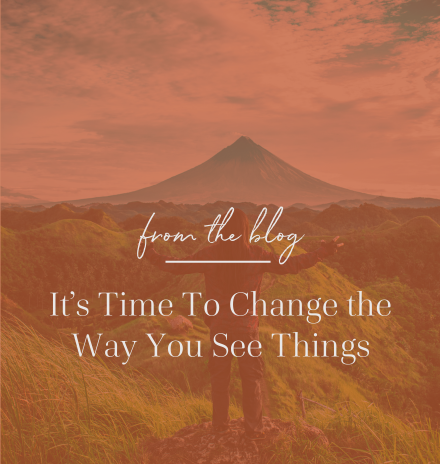
It’s Time To Change the Way You See Things


I walked into my house after nine months away. The familiar walls welcomed me like an old friend.

As I unpacked my things—and those of my two college daughters who had just returned—I started seeing things I hadn’t noticed before.

Way too many clothes jammed into that closet.
A plant blocking the light in the corner.
A backyard that needs some love.
Even driving around town, I caught myself smiling at things I’d never paid attention to.

The house hadn’t changed. But I had.

My perspective had shifted—and with it, my ability to see what I’d been too busy to question.

It wasn’t just the physical stuff. I noticed responsibilities I’d taken on that didn’t serve me anymore. Maybe they never did.

Living away for nine months—supporting my son’s journey—gave me a gift I didn’t know I needed: a different perspective.

We all know perspective shapes our lives. Like when a doctor tells two patients with the same disease that they have six months to live. One goes home to prepare to die. The other says, “No way. I’ve got grandkids to watch grow up.” One passes away shortly after. The other thrives for several more years.

Same situation. Different perspective. Different outcome.

How we look at a situation determines how we respond.
How we respond shapes our results.​
​Our perspective, therefore, shapes our destiny.

You’d think we’d be experts at expanding our perspective, right?
But the truth is… we’re not.

Here’s why.

It’s easy to forget that our perspective is just that—a perspective, not a fact. We get stuck seeing the world the same way every day. We look for evidence that confirms what we already believe—rather than challenging it.

It’s like being a fish in a fishbowl. The fish doesn’t even know it’s in water because it’s always been there.

For over two decades, I’ve helped men and women revolutionize their lives and leadership—so they can increase their happiness, impact, productivity, and bottom lines.

And here’s the secret sauce: every transformation starts with a change in the way we see things.

When we change the way we see things—the things we see change.

Even the tiniest shift can be revolutionary. Like a golfer who changes their grip by just a centimeter—and suddenly the ball goes in a completely different direction.

My time away reminded me: I must never stop seeking fresh perspectives—even when life feels good.

This fall, in my new hybrid coaching program, The Inner Game Advantage, we’ll use perspective shifts to reset, amplify your happiness, and increase your influence.

But you don’t have to wait until then. Here’s your summer homework:

Ask yourself these questions:
👉 Where am I stuck in the same patterns, just because that’s the way I’ve always done it?
👉 What am I not seeing that’s holding me—or others—back?
👉 What’s another perspective (or seven) that could change everything?

Summer is the perfect time to explore new perspectives. Its slower pace and longer days invite us to pause, reflect, try something new, and play.

Maybe it’s a weekend getaway to somewhere you’ve never been.
Or reading a book you’d normally skip.
Or having coffee with someone who challenges your thinking.

Even a simple walk—without your phone—or an evening journaling in the backyard can unlock new insights. When we give ourselves space to see things differently, we discover possibilities we never knew existed.

Life becomes better than we imagined.

This fall, I’ll be trekking the Inca Trail to Machu Picchu—a trip I’ve dreamed about for years. With how much perspective has expanded for me lately, I can’t wait to see the world from yet another vantage point. Stay tuned. I promise to share the perspectives I find with you.

In the meantime, here’s to seeing your world—and your leadership—with fresh eyes.

All my best,
~Rita

P.S. Curious how seeing things differently could revolutionize your life, leadership, and productivity? Let’s chat, and we’ll schedule a Connection Call. Let’s explore what’s possible with a fresh perspective—and a coach in your corner.

https://www.ritahyland.com/wp-content/uploads/2025/06/June-Newsletter.png 464 440 Joyce Polintan https://www.ritahyland.com/wp-content/uploads/2020/04/Rita-Hyland-1-line-blue-NOTAG-01.svg Joyce Polintan2025-06-10 17:20:202025-06-19 09:54:24It’s Time To Change the Way You See Things
best self

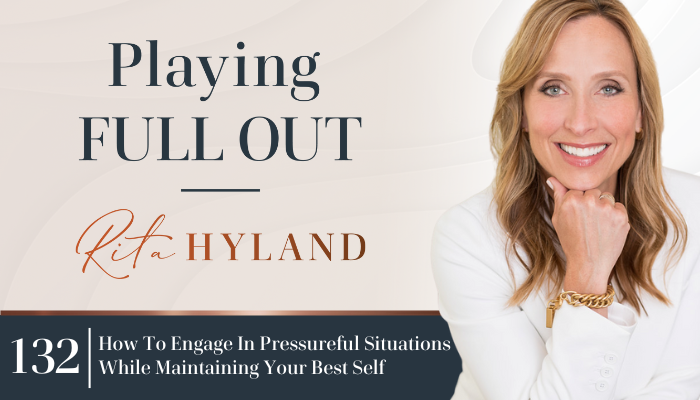
How To Engage In Pressureful Situations While Maintaining Your Best Self

best self

Listen to the full podcast episode to learn about the science-backed practice that has not only changed my life but also the lives of countless people over the last two decades. This is something you can’t ignore if you want to achieve that great goal you identified for this year and write your new future.


​​How do you engage in pressured situations while maintaining your best self? What do you do to manage and prevent stressful situations from negatively impacting your behavior?

In an ideal world, we don’t feel pressure at all—we hold boundaries, disarm conflict, and let things roll off our back. But we know that’s not reality all the time, right? We are complex creatures with emotions and past experiences that can trigger us. Whether it’s deadlines, difficult conversations with colleagues, or even complicated family matters — pressure is an unavoidable part of life. 

Of course, being self-aware is the first and foremost way to decrease our reactivity. By examining what triggers us, shining a flashlight on our blindspots and peeling back the layers, we can unlock our best selves and our best levels of leadership. BUT what do you do when the pressureful situation still strikes and you are knee-deep in it? 

In this episode, I’ll dive into how we can handle these moments in real-time without losing control and instead become models of the behavior we most want to see in our board rooms, classrooms, and family rooms. 

The Reality of Pressure and Its Impact

Recognizing and understanding why we feel pressure in different scenarios can help us improve our self-awareness in the moment.

In a meeting I witnessed a team member, Tom, becoming increasingly agitated. His voice grew louder and more aggressive. The tension was evident and most in the room grew progressively uncomfortable. But then, Tom did something extraordinary. He paused, took a breath, and became aware of his behavior in real-time. Tom performed a quick self-assessment and chose to change his approach. He then apologized, acknowledged the pressure he was under and said that it still didn’t justify his behavior. This honest self-assessment and admission not only transformed Tom, but also transformed others in the room, allowing everyone to relax and feel compassion. It brought the team back to the real issue, enabling us to work together more effectively. 

The Way We React to the World is Significant

Unexpected and uncontrollable events happen all the time. So, we need to know what we can do to avoid being hijacked by these moments and instead maintain our best selves. We need effective strategies. The good news is that there are ways to dismantle and redirect these pressureful situations before they escalate or harm our relationships and careers.

Here are the Five Steps to Maintain Your Best Self Under Pressure 

  • Be Aware of the Moment

Recognizing these pressureful moments makes all the difference. It might seem simple, but it’s not. Pressure triggers an instinctive response from our sympathetic nervous system, often before we’re even aware of it. Noticing physical signs like increased heart rate, faster speech, or sweaty palms can help you become aware that you are moving to a flight or flight response.

  • Pause

Once you’re aware of a pressureful situation, pause. This allows you to become an objective observer of your situation. By stepping outside yourself and looking back — neutrally —  you can see your behavior as it’s occurring. Slowing your heart rate down with deep breathing is extremely influential when you notice the physical experience of fear manifesting in your body. One simple way is to inhale for four, hold for seven, exhale for seven. This will reduce the pressured feeling in the moment and move you from a reactive to a calm state. 

  • Give Your Pressured Self a Direction

When I feel pressured, I am open to help.  The good news I’ve learned is that we can actually help ourselves in these moments. For me, the simple direction of “release” can take me back to my center. It’s like telling a dog to drop the bone. This simple direction can shift me when the pressure is mounting and I feel more defensive or aggressive in a certain moment. 

Becoming defensive under pressure is a very natural and common way we armor up to protect ourselves when we interpret a situation as threatening. Unfortunately, being defensive (other than when we are being physically attacked) is also unproductive and detrimental. You can’t be at your best—thinking clearly or solving problems effectively—when you’re defensive. So, when you feel the urge to react negatively, remind yourself to “release” the fear or tension in that moment. 

  • Perform a Self-Assessment

We know that when we feel pressured, we’re often driven by fear or worry. Certainly not our best selves. To get to the root of why this is, ask yourself these two questions: “What am I really afraid of?” and “What is my truth”? Often, our fears are irrational and identifying the truth allows us to return from our pressured selves back to our best selves. 

This was best demonstrated by Tom when he was able to do this in real-time and owned what he feared — that his team wouldn’t perform and that would lead to his failure and judgment from stakeholders. He then identified what was as true (or more true) than his fear, that he could lead his team to successful completion with his colleagues’ support. By pulling out of his fear, he was able to not lose control and instead access better resources and support.

  • Follow the #1 Leadership Principle: Lead from Love

One way to practice this is to ask yourself, “What would love do here?” This principle helps you respond with empathy and compassion rather than fear and defensiveness. Choose to lead from love even when the pressure is on. 

Now, whenever you feel pressure rising, you have a complete process to help you rise as an employee or leader:

    1. Be aware you’re in a pressure moment. Name that pressureful moment.
    2. Pause. Objectively observe yourself.
    3. Give direction and help your pressured self.  Simply provide the part of you that is in fight or flight to  “release.”
    4. Perform a self-assessment. Start asking yourself, “What am I afraid of?” and “What is the truth?” Then behave according to the truth.
    5. Lead from Love. 

Remember, if you shut down, others shut down. When you stay calm you will elicit calm from others. 

In each pressured moment lies an opportunity to exhibit your highest potential. Use these strategies to transform pressure into growth and demonstrate emotional maturity that sets you apart and drives you towards more substantial, fulfilling outcomes in every area of your life.

In this episode, I share:

  • How to recognize a pressured moment as it’s rising 
  • How to avoid reacting and instead dismantle a pressured situation like the great leaders do
  • Five simple, practical steps you can use in real-time to maintain your best when the pressure is high
  • The role and advantage of self-awareness when the stakes are high and the decisions matter

Resources and related episodes:

  • Tune in to the previous episode, (Part 2) Enrich Your Relationships with The Enneagram and Leslie Neugent
  • Try these Mindfulness Apps: Apps like Headspace or Calm can help you develop mindfulness practices.
  • Read the book, “Emotional Intelligence” by Daniel Goleman
  • If you’d like to be notified of when new podcast episodes are released, you can do so here: Playing Full Out
  • Learn more about the Inside Out Method
  • Connect with Rita on LinkedIn

Subscribe on Apple Podcasts for more tips, tools, and inspiration to lead the optimal vision of your life, love, and leadership. Remember, a half version of you is not enough. The world needs the fullest version of you at play.

Listen on Apple Podcasts

___

About Rita Hyland

With over 20 years of experience as an executive and leadership coach, Rita helps leaders — emerging and established — excel in corporate and entrepreneurial environments.

Rita believes if leaders were more clear about how transformation really works and more intentional about creating what they want, their impact, success, and influence in the world would be unstoppable.

Through her coaching programs, private coaching, and masterminds, Rita shows leaders how to win consistently and create the impact and legacy they desire.

Central to Rita’s work is the understanding that you will never outperform your current programming, no matter how strong your willpower.

When you learn to use Rita’s proprietary Neuroleadership Growth Code, a technology that uses the best of neuroscience and transformational psychology to hit the brain’s buttons for change, YOU become both the solution and the strategy.

Her mission is to end talented, hard-working, and self-aware leaders spending another day stuck in self-doubt or confusion and not contributing their brilliant work and talent the world so desperately needs.

https://www.ritahyland.com/wp-content/uploads/2024/05/maintaining-best-self.png 464 440 Joyce Polintan https://www.ritahyland.com/wp-content/uploads/2020/04/Rita-Hyland-1-line-blue-NOTAG-01.svg Joyce Polintan2024-05-23 05:00:122024-05-24 15:14:37How To Engage In Pressureful Situations While Maintaining Your Best Self

Not Another Thing

another thing


“Rita”, she said, “You must embrace that you are worthy of unconditional love.”

‘What did she just say?!?’ I thought to myself as I sat in my first experience with a life coach over 25 years ago.

I’d decided to meet this woman after hearing about her and this young profession from a friend. My intention of the meeting was that she would help me identify a more satisfying career.

My first assignment, however, startled me: embrace that you are worthy just as you are.

Besides the fact that it felt uncomfortable, what did that have to do with me getting a satisfying career — or anything else I wanted for that matter?

What I hadn’t seen before was that most of my life I had been hustling to achieve, please and get it right because on a deep level I hadn’t believed I was worthy. Instead, I believed that if I accomplished and achieved enough I’d get there — I would be enough.

My belief had driven me to spend long hours perfecting my work, working out constantly, taking on assignments I didn’t want and accepting invitations I’d rather have declined.

Of course, I hadn’t seen any of this at the time, but it made sense. As long as I could remember, even after accomplishing a bunch of things or that one big thing, I didn’t feel the way I thought I’d feel —something always felt like it was still missing.

At the time of my meeting with this coach, I thought it was a different or better career that would give me the satisfaction and fulfillment I was yearning for.

So why am I sharing this and what does this have to do with you, your career, business or leadership?

What I am seeing today is that for many at this stage in their career and life, they are realizing that despite having accomplished those things that they thought would make them finally feel fulfilled or satisfied, they’re still missing the feeling of internal satisfaction.

And it’s frustrating because they’ve done all the things society told them to do and be, but they are not feeling what they thought they’d feel.

If you’re an entrepreneur, boss, or leader of a team and you have the title and the business results, but you struggle feeling worthy enough or you regularly deal with imposter syndrome, it will show up in your decision-making. You’ll second guess yourself, stagnate, possibly sabotage yourself and for sure keep hustling to feel that you are enough. If you’re stubborn like me, you may even do it until your body completely shuts down and forces you not to work so hard — or at all.

Let’s be clear, in all my years nobody has ever come to me saying they have a self-worth problem. Most — just like I did — believe they have a career problem, business problem, relationship or leadership problem — never a self-worth problem.

But by the numbers as Jamie Lima Kern reports in her new book, Worthy, 90% of women struggle with not feeling enough. 73% of female account executives battle with imposter syndrome and 70% of men have feelings of being inadequate.

These are big numbers!

So how do you know if you are struggling with not feeling enough?

If you struggle with speaking up in the big meeting, asking for what you want, resting, raising your hand for a new role, saying what you think, promoting yourself, enjoying who you are, holding a boundary, or working less — believing you are enough may be a place to explore.

When we feel worthy we overcome performance anxiety, we act on our great ideas, we face obstacles head on, we are generous with others, and we make better decisions. When we feel worthy we see things accurately and can enjoy what we have created without needing to do another thing.


What I am saying is we can spend our lives seeking the next level of accomplishments and we can do all the things we think will help us, for example, to slow down at work, but if we don’t believe that deep down we are worthy enough of working less — or in my case of a satisfying career — it will never happen.

Trying to feel fulfilled by accomplishing more is like threading a needle while wearing boxing gloves. It’s impossible, because while achievement can make you feel a lot of things — strong, proud, empowered, self-confident — it can never make you feel worthy.

I’m not saying that going after our goals and aspirations isn’t great, but when it is motivated by a belief that it will make us feel enough, we’re sure to be left unsatisfied.

The question we need to ask ourselves is what is our motivation for working so hard or seeking to achieve our next level. Is it for the joy of the experience? To test and know our edges? To make a positive difference? Or is it to fill a missing feeling of satisfaction and fulfillment within us?

The reason it matters is because nobody, no accomplishment, no external measure will ever give us that feeling, the unidentified missing feeling of fulfillment that we are enough as we are.

This is what my coach wanted me to get that first day. I’d made most of my decisions to that point based on the false belief that I was not enough, which had led me to making a series of poor decisions.

She wanted to make sure I didn’t continue that pattern as I made my next big decision.

We have to learn how to believe again that we are worthy. It’s not impossible. Since day one we’ve been worthy. It’s the world that convinced us we are not.

After having the honor and privilege to work with many people often much smarter than myself to improve their well-being and positive leadership imprint, I have learned that your self-worth is the foundation of your fulfillment. That you’ll never feel fulfilled without it.

The reality is that I still work on my self-worth everyday. I can see when I am stalling on an important decision, not accepting a challenge or not showing up as myself but as I think I should to get approval from others. It’s in these moments that I realize I am questioning my worth. It’s also then when I take a moment to do the very things I encourage my clients to do.

When you learn to feel that you are enough, it will allow you to stop working so hard. And while it may seem counter-intuitive, you’ll still be productive and achieve great things — you’ll just enjoy and be more satisfied while you do.

If you are someone who wants to slow down and enjoy what you have achieved, developing your self-worth is your first step.

One of my favorite ways to begin is with what I call a “Worthy List.” Start by noting what you want to do, feel, or experience. Write it down on a piece of paper or in a journal. Then in front of each of your desires, simply write, I am worthy to. It looks like this.

I am worthy to rest

I am worthy to sit still

I am worthy to be in this big meeting

I am worthy to take a vacation

I am worthy to sell this business

I am worthy to lead this account

I am worthy to be home in time for dinner

I am worthy to say what I want

I am worthy to step out of the office

I am worthy to say “no more” to the work that I don’t want to do

I am worthy to say “no thank you” to the invitation

Right now you are truly worthy exactly as you are, and it doesn’t mean you stop pursuing your goals, dreams and aspirations. It means you don’t pursue them with the belief that they will ever make you feel fulfilled. What you want is that when you do hit them, you are able to enjoy them. And if you don’t, you feel worthy, satisfied and fulfilled regardless!

Building your self-worth is the best decision you can make for your business, your team, your children, and your leadership.

There’s never been a better time to cultivate it!

All my best,

~Rita

https://www.ritahyland.com/wp-content/uploads/2024/03/Not-Another-Thing.png 464 440 Joyce Polintan https://www.ritahyland.com/wp-content/uploads/2020/04/Rita-Hyland-1-line-blue-NOTAG-01.svg Joyce Polintan2024-03-28 17:03:542024-05-03 16:49:26Not Another Thing
michael quinlan

What Does It Take To Transform with Michael Quinlan

michael quinlan

Listen to the full podcast episode to learn about the science-backed practice that has not only changed my life but also the lives of countless people over the last two decades. This is something you can’t ignore if you want to achieve that great goal you identified for this year and write your new future. I’m incredibly excited to have Michael Quinlan with us for this episode. Michael is a regional vice president of sales at SAP, a transformational leader, a father, and a man I’ve had the pleasure of knowing for several years.


Michael is passionate about personal development and has a willingness to consider things from a different vantage point, even if it humbles his ego. After attending the SAP Masters program for leadership in London, he published a paper on transformational leadership called What Does it Take to Transform? Michael is joining us to share his story of personal and professional transformation and what leaders can do to evolve themselves and those they serve. 

“My journey into leadership was something that I really never had intended.” – Michael Quinlan

Michael had always envisioned himself as a salesperson who would make his career out of taking down big deals. After 20 years in his role and accomplishing the goals he wanted to achieve as an individual contributor, he had the itch for something more. When he realized the impact he could make by helping others in his company, he decided to step into a leadership position but quickly hit a wall.

“The training that we received was minimal at best. […] There was never any development around what it takes to lead and motivate and develop a team. So my leadership style, since I really didn’t have one, was just imitating what I had seen from leaders that had been over me in the past.” – Michael Quinlan

It’s common for people who excel as individual contributors to step into a leadership role and struggle because they lack the skill set to motivate and develop others on their team. Often, they rely on hand-me-down leadership approaches without fully understanding their purpose.

Then Michael came across the SAP master’s program on leading sales transformation.

“Transformational leadership is absolutely showing up in front of your team with trust and with vulnerability. In order for somebody to feel like they can transform, you really have to do it yourself first.” – Michael Quinlan

Transformational leadership requires self-evaluation, personal growth and actively engaging with your team to create a supportive environment. When you care for your employees and help them overcome their weaknesses, you build trust and increase productivity and performance.

“The hardest thing to do in coaching is to not give the answer.” – Michael Quinlan

Bosses give the answer; coaching managers ask questions that prompt self-reflection and empower the individual. This approach enables employees to take ownership of their words and actions and fosters personal development. When we give the answers, we reinforce an individual’s insecurity and uncertainty, taking away their power and making them more dependent on us.

There are three obstacles to transformational leadership inside a corporation:

  1. Mislabeling the type of problem
  2. Corporate hierarchies and centralizing decision-making
  3. The perception of risk

“People in middle management positions can have a big impact on the world that we live in.” – Michael Quinlan

Middle managers bridge the gap between resource-rich corporations and individuals who can execute the initiatives that would create positive change. It becomes disconcerting when these corporations have the resources to make these changes happen but aren’t willing to transform.

In a survey of 3,400 people, 70% said that their mental health is as influenced by their boss as by their spouse.

We need to acknowledge the level of influence we have to empower and bring out the best in our employees. By bravely stepping into the role and embracing vulnerability, we enable others to follow suit.

In this episode, we discuss:

  • Michael’s journey into leadership and the challenges he faced
  • The principles of transformational leadership and how they can positively impact teams and organizations
  • The three major obstacles preventing us from the transformative change in the workplace
  • Michael’s advice for transformation as an individual, leader, and team

Resources and related episodes:

  • Tune in to the previous episode, How to Break the Habits That Limit You with Hypnotherapist Christina Woods
  • Listen to episode 51: Love is the First Essential Leadership Principle
  • If you’d like to be notified of when new podcast episodes are released, you can do so here: Playing Full Out
  • Learn more about the Inside Out Method
  • Connect with Rita on LinkedIn
  • Read Michael’s publication, What Does it Take to Transform?
  • Learn more about SAP

Subscribe on Apple Podcasts for more tips, tools, and inspiration to lead the optimal vision of your life, love, and leadership. Remember, a half version of you is not enough. The world needs the fullest version of you at play.

Listen on Apple Podcasts

___

About Rita Hyland

With over 20 years of experience as an executive and leadership coach, Rita helps leaders — emerging and established — excel in corporate and entrepreneurial environments.

Rita believes if leaders were more clear about how transformation really works and more intentional about creating what they want, their impact, success, and influence in the world would be unstoppable.

Through her coaching programs, private coaching, and masterminds, Rita shows leaders how to win consistently and create the impact and legacy they desire.

Central to Rita’s work is the understanding that you will never outperform your current programming, no matter how strong your willpower.

When you learn to use Rita’s proprietary Neuroleadership Growth Code, a technology that uses the best of neuroscience and transformational psychology to hit the brain’s buttons for change, YOU become both the solution and the strategy.

Her mission is to end talented, hard-working, and self-aware leaders spending another day stuck in self-doubt or confusion and not contributing their brilliant work and talent the world so desperately needs.

https://www.ritahyland.com/wp-content/uploads/2023/05/RH-Podcast-Featured-Graphics-118.png 464 440 Joyce Polintan https://www.ritahyland.com/wp-content/uploads/2020/04/Rita-Hyland-1-line-blue-NOTAG-01.svg Joyce Polintan2023-05-25 05:00:192024-03-01 16:49:15What Does It Take To Transform with Michael Quinlan
plain sight

What Was In Plain Sight…

plain sight

Years ago (nine to be specific) I was on Oprah. That may sound glamorous, but I was not on Oprah for the reason someone like me would dream of being on Oprah.  It was when my oldest daughter was 10 years old.  

There was a popular conscious parent coach named Dr. Shaefali who was looking for kids to interview about relationships with their parents for a two-part series. Clips from the conversation would be used during the live show with Oprah and the kids’ parents in the audience.

My daughter was one of the kids interviewed.

When my husband and I arrived with the rest of the audience on the day of the live taping with Oprah and Shefali, the producers took my husband and me aside to ask if we were willing to be mic’d up. That was when I heard a producer’s radio, “Please seat the Hylands in the front row.”

Oh no. I hadn’t planned on this. I started to sweat. My husband whispered reassuringly, “I never thought this was a good idea.” 

When the lights went on and the show began, my daughter’s face appeared on a two-story screen. Dr. Shefali asked the group of children, “If there were a couple of things you could tell your parents about how to be a better parent, what would you want them to know?”

My daughter’s response: “Sometimes when I feel pressure and I talk to my mom about it, I don’t really need her to always go into a working mode of how you can solve things and fix things, sometimes I just need — this next word comes out slowly —  a hug.”

Either a mic dropped or my heart did.

At that point, the camera shot over to my husband and me in our seats. Oprah turned toward us announcing, “We have Casselry’s parents with us in the studio audience today.”

Oprah directed the next question to me: “When you hear what your daughter has to say, are you surprised?”  

In part, I was stunned. The other part of me was not. At that moment, I realized how often I was running around trying to function — get things done, raise three young kids, meet the demands of work —  so much that I wasn’t aware of how I was listening or speaking to my daughter and what she truly wanted in these moments.

After this international humbling, I committed to doing a better job listening, to be there for her and all of my kids — to be present.  

Unfortunately, I still hadn’t gotten it.

Fast forward years later and she’s a teenager.  We’re having a conversation where she’s struggling with something. I started offering solutions to the problem — I wanted to try to take her struggle away.  She got irritated with me. I’d been here before.  She was irritated by the way teenagers too often are with their parents. Her response was, “You don’t understand. You don’t get it.”  

And she was right. It had been in plain sight for years, but I’d missed it.

What I realized is that I was so busy trying to fix something it turns out she wasn’t asking me to fix. I was pushing my own agenda to get things accomplished or remove her pain because of what I interpreted that may say about me as her mother.  

Worst of all, I realized that each time she came to talk to me in her moment of uncertainty and I provided ways to fix her struggle, I was actually making her MORE uncertain, MORE insecure.  

The thing is I hear the same thing in my conversations with adults — key contributors, experts, and leaders themselves in their craft — people like yourself or those who report to you.  

They say something similar to what I heard my daughter say. “My manager doesn’t get it. He doesn’t listen. He only sees things one way.” “My manager, she’s got her own way of doing things. She doesn’t understand.”

And here’s the worst part about these moments: it’s not what’s said on the surface — that we don’t get it. It’s the underlying message that’s often interpreted when we try to solve others’ problems or fix things even when we’re not being asked.

The message delivered is either:

I don’t believe in you and your abilities enough to figure this out on your own.

 – or – 

I am so uncertain and insecure at this moment, that I need to pile on solutions to take me out of my own discomfort. 

Both of these messages —  whether we are aware of it or not — compound any existing uncertainty an individual already has.

Why is this important? Because…

INSECURITY MASKS WISDOM.  

We are in the midst of a period of mass uncertainty. For the last few years, we couldn’t be confident what was happening 48 hours from now. Add the rise and fall of the economy, the perceived unreliability of banks, job lay-offs, and weekly shootings in our schools and churches, not to mention life’s own organic disruptions —  and you have a breeding ground for uncertainty and insecurity.

When a person is insecure and uncertain their access to their wisdom — meaning their solutions, creative ideas, and next steps — is blocked. 

And as I was doing with my daughter, when we move too quickly to ‘fix’ others’ struggles, we unwittingly contribute to the uncertainty which undermines and blocks their wisdom. 

Whether you’re a parent, coach, or corporate leader — providing space and confidence is a key part of managing and leading people — especially in uncertain and changing times. 

When we don’t insist on pushing our solutions on others we often notice a surprising thing happening. Individuals, teams, and even our children begin to unravel and resolve the problem themselves. As a result, they become more engaged and empowered.

Bottom line: We will never rid the world or others of uncertainty and insecurity, but we certainly can avoid contributing to it. 

I’ve finally seen what was in plain sight all along. 

Today, when my children come to me with their struggles or problems, you’ll hear me saying, “I’m sorry; that stinks; that never feels good; it’s hard being a kid today.”   

At other times, you might find me simply giving — a hug.

https://www.ritahyland.com/wp-content/uploads/2023/05/RMJ-Newsletter-04_2023-1.png 464 440 Joyce Polintan https://www.ritahyland.com/wp-content/uploads/2020/04/Rita-Hyland-1-line-blue-NOTAG-01.svg Joyce Polintan2023-05-10 16:55:452023-05-10 17:18:34What Was In Plain Sight…
Resolving conflict like a pro Playing Full Out Rita Hyland

Resolving Conflict Like a Pro

resolving conflict like a pro playing full out rita hyland

Listen to the full podcast episode to learn 3 simple steps to show you how to use anger as a powerful tool and produce transformative, desired outcomes during conflict resolution. 

It happens to us all: someone treats us unfairly, our opinion is disregarded, we feel our contributions at work or home are undervalued. Slowly, and sometimes instantly, we become ANGRY. “How dare they!” we think to ourselves. Does this sound like a familiar, maybe even recurring experience for you? If so, I want to show you what you can do when you feel yourself getting angry at someone, how to use anger as a powerful tool, and what to do to transform that anger into positivity, productivity and peace.

A problem we all face in the world today is the presence of tons of reasons to feel triggered and angry.

We can find them in our news, politics, workplaces, communities, and maybe even in our families. Then, when we’re faced with so much anger, we inadvertently become angry, too. But, if all of us are in a triggered state feeling angry, how can we do the work that we need for conflict resolution?

One thing you might not know  I do in my work is conflict resolution in relationships. In fact, it’s a lot of what I do whether implicitly or explicitly. I am often called  to resolve conflicts between a manager and an employee, partners at a firm, department heads, and even between spouses. In most cases, the hurt, judgment, blame, and anger in these situations is high.  It’s common then for both parties to get ensnared by anger. But why? Why is there so much anger?

Our anger is a form of protection for when we feel threatened.

Our body is doing what it is inherently called to do. It triggers our sympathetic nervous system to fight, flee, or freeze in order to save us. Which of these three coping mechanisms we choose is usually determined by what worked for us at a younger point in our lives. When something works for us, we repeat it.  Eventually it becomes an automatic response —  an immediate reaction that shows up whenever we get angry.

Here’s where the problem shows up – when we react with anger, blame, and indignation, we end up either destroying relationships and opportunities or severely impeding their growth.  Anger also comes with a significant cost to our health in the form of anxiety, high blood pressure, and heart attacks – just to name a few. 

How can you become better at navigating your anger rather than being sabotaged by it?

Believe it or not, you can learn how to turn anger into positive energy through a proven 3-step emotionally intelligent process.  It’s one that differentiates the evolved, self-aware individual and leader from others. Let’s get into the steps.

Be curious. Not furious.

Lead with curiosity. When you’re feeling hurt, try to slow down your reaction. Instead of throwing anger and blame, be curious and begin to ask questions seeking to find something you didn’t know. Did someone cut you off in traffic triggering your road rage? Slow down and curiously ask yourself, “I wonder why he’s driving so fast…” What am I missing? What am I not seeing adequately? What may I not be considering? What else do I need to know here?

When you start by making assumptions, your own preconceived notions about how they are reacting to you are actually influencing how those people react. Believe it or not, you are actually much more in control of the responses you’re getting. If you change your perspective and think about things differently, 9 times out of 10, you’re going to get different responses, reactions, and results.

Assume positive intention.

Especially until you know otherwise. Give the opportunity for someone else to be heard for their intentions and to be seen accurately as opposed to what your primal angry, protective, threatened brain is conjuring up in a moment where it feels under siege.

Choose to connect.

Share something about you with the person you’re angry with that they might not know. Show your humanity. Be emotionally honest. What happens in the Law of Reciprocity is that what we give, someone else wants to respond in kind. So, if you’re choosing to connect, to be human, to be emotionally honest, it’s likely you are going to get the same thing back in return. This is how you begin to have more power over creating peace than you’ve previously recognized or owned. 

You can be passionate and defend your position down to the death, but the wisest know when to end the attack and anger and begin to be curious.  The wisest know when to see the humanity in the other person, to give them compassion and empathy. 

When you’re angry, be sure to discern whether you’re spending your energy wisely or getting caught up in an exhausting spiral of resistance just for the sake of being angry. 

Some of the best advice for living an open-hearted life and becoming a conflict resolution master is to remember a quote from Socrates: 

True knowledge exists in knowing that you know nothing. 


If you choose to operate from this mindset, you’ll find yourself always in a state of being curious. You’ll drop the assumptions that are evoking the negative, undesired behaviors from others. You’ll start asking questions, having more compassion, and naturally engage and connect with others showing them your own humanity. 

The bottom line is that anger is not a bad emotion. It is a messenger that is absolutely necessary at times to keep us safe and alive. Too often, however, we believe there are things threatening our existence that really aren’t. Instead, they may simply be threatening our ego  or maybe our reputation.  

If you find that anger is preventing a deal from going through, a team’s best production, you getting promoted, or a relationship with a family member thriving, begin repeating to yourself the mantra, “Be curious, not furious.” Your results will change each and every time. You’ll also improve your status as a leader, parent, spouse, and friend. 

In this episode I share:

  • Real-world examples of how anger triggers us and leads us to immediately react in destructive ways
  • What anger really is and why it’s important in our lives
  • My go-to transformational 3-step process to shift your immediate reaction to anger into a mindful state of curiosity that turns around conflict and creates positive, desired outcomes
  • The emotionally intelligent behavior that differentiates evolved, self-aware individuals and leaders from angry individuals who unwittingly sabotage and destroy relationships and opportunities

Resources and related episodes:

  • Tune into the previous episode, Leading From a Heart at Peace
  • Episode 99. How To Boost Your Patience, Energy, and Progress So You Do the Best Work Of Your Career
  • If you’d like to be notified of when new podcast episodes are released, you can do so here: Playing Full Out

  • Learn more about the Inside Out Method
  • Connect with Rita on LinkedIn. 

Subscribe on Apple Podcasts for more tips, tools, and inspiration to leading the optimal vision of your life, love, and leadership. Remember, a half version of you is not enough. The world needs the fullest version of you at play.

Listen on Apple Podcasts

___

About Rita Hyland

With over 20 years of experience as an executive and leadership coach, Rita helps leaders — emerging and established — excel in corporate and entrepreneurial environments.

Rita believes if leaders were more clear about how transformation really works and more intentional about creating what they want, their impact, success, and influence in the world would be unstoppable.

Through her coaching programs, private coaching, and masterminds, Rita shows leaders how to win consistently and create the impact and legacy they desire.

Central to Rita’s work is the understanding that you will never outperform your current programming, no matter how strong your willpower.

When you learn to use Rita’s proprietary Neuroleadership Growth Code, a technology which uses the best of neuroscience and transformational psychology to hit the brain’s buttons for change, YOU become both the solution and the strategy.

Her mission is to end talented, hard-working, and self-aware leaders spending another day stuck in self-doubt or confusion and not contributing their brilliant work and talent the world so desperately needs.

https://www.ritahyland.com/wp-content/uploads/2022/07/Resolving-Conflict-Like-a-Pro-Rita-Hyland-Playing-Full-Out.png 464 440 Joyce Polintan https://www.ritahyland.com/wp-content/uploads/2020/04/Rita-Hyland-1-line-blue-NOTAG-01.svg Joyce Polintan2022-07-21 05:00:152024-03-01 17:03:33Resolving Conflict Like a Pro
Leading from a Heart at Peace Playing Full Out with Rita Hyland

Leading From a Heart at Peace

Podcast episode title graphic: Leading From a Heart at Peace Playing Full Out with Rita Hyland

Listen to the full podcast episode to learn what your exceptional solutions to daily problems are missing and what you must do BEFORE your best ideas are ever heard by people at work, at home, and in all areas of your life.

This may be a tough question, but have you ever found yourself wondering why are people not listening to your super strategy? Maybe you’ve offered several stellar solutions at work and are even delivering high performance, but you’re still not being advanced?  Or maybe you’ve told your kids exactly what they need to do to clean up after themselves at home, but nothing’s changing. If you know you can solve a big issue with a great solution, but you’re finding resistance from others, you’re in the right place.

Here’s the thing: it’s likely not that your solutions aren’t great. The problem is actually a common one I see with many top talented individuals when it comes to solving problems at home, at work, and in other areas of their lives.

THE PROBLEM

Too often the problem begins in our approach to solving a problem. We tend to approach problems with a mindset that believes that not only does the problem need to be fixed, but so does the other person. When we approach others as something that needs to be corrected, we’re leading from what is called a “Heart at War.” 

We feel we know better, that we are better, and that we deserve better. We then approach the other person from a place that’s filled with judgment, self-righteousness, and close-mindedness. A Heart at War sees others as “the problem.” Others are the roadblock on the path to the clear solution and are something that needs to be fixed – just like the problem.

This mindset approach immediately blocks our solutions from working. At best, the solution is diminished. At worst, the problem is dismissed.  As a result, we continue the circle of blame, justification, and disdain. 

THE SOLUTION

Instead of a Heart at War, we need to lead from a Heart at Peace. Let me explain what this means.

When leading from a Heart at War, we’re in judgment and we lead with “I’m better” thoughts. 

When leading from a Heart at Peace, we see the other person simply as a person, not as something broken that needs to be fixed. We see them as a person who’s just like us with real concerns, needs, ideas, and solutions. We’re interested in them, we’re curious, and we’re open-minded. 

WHY THIS IS SO IMPORTANT

If we’re leading with a Heart at War, it doesn’t matter how great our solutions to problems are – the solutions will fail every time.

Whether it’s at home or work, peace is only capable when an intelligent solution is connected to a peaceful inner strategy. This concept comes from two of my favorite books by The Arbinger Institute that I highly recommend: 

  • Leadership and Self-Deception
  • The Anatomy of Peace: Resolving the Heart of Conflict

As a leader, it’s no longer enough to find the right solution and simply “get it done.” It doesn’t matter how good your strategy is, how productive you are, or how top tier talent you are. You can be the most intelligent leader in the world with access to the best consultants, therapists, and solutions money can bring. But, if your approach is always beginning from a Heart at War, your solutions will go nowhere. 

HOW TO LEAD WITH A HEART AT PEACE

The key to getting your solutions across, to being heard at work, to getting your college daughter to clean up after herself (speaking from personal experience here) is to pair your five-star solutions and strategies with inner peace. It’s important that you have peace within yourself before moving to find peace outside with others. Here are some ways to get there.

Always Be Aware

When you find yourself blaming others, justifying, or feeling the need to correct or fix another, these are all signs of a Heart at War. Unless we’re aware of a problem, we can’t fix a problem. What’s also important is becoming aware of the fact that there’s something underlying the problem.

See the Other Person as a Person – Not something that’s broken

Are you seeing the other person as an object or as a person just like yourself who’s wanting to find a proper solution? In every moment, in every interaction, determine how you are seeing the other person. It’s often when we feel justified that another person is the threat to our solution that we judge them, see them as less than ourselves, and believe they need to be corrected. 

To dive deeper into the concept of this second step, I highly recommend reading Leadership and Deception by The Arbinger Society. 

Move Your Vantage Point

Begin to consider the challenges this person (or persons) is having in this situation. What pain are they experiencing in their own world? Be curious about their worries and their concerns. Although we start to pit ourselves against each other, we’re often all on the same team. 

Ask Yourself This Question

Honestly say, “When have I done what I’m judging the other person for?” This is what I instantly go to. This question is an immediate way to shift a Heart at War. You’ll find it quickly humbles the ego and brings in compassion for the other person.

Lastly, Take Action

It’s not easy to really be conscious of and to call ourselves out on our own stuff. It takes a self-aware person with their own inner peace and their genuine interest in lifting other people up to really solve problems. 


THIS WEEK’S CHALLENGE

Notice a place where you’re leading with a Heart at War. Where are you judging someone or a group of people? Over this next week, practice approaching that problem with a Heart at Peace instead. Approach the problem with interest, genuinely caring for the other person or persons, and assume their positive intent.

Again I say, it does not matter just that you get it done. If you’re a leader, it matters how you got there. When you show up at your best, you put down your need to be right. You release blaming, indignation, and your need for vindication to replace a Heart at War with a Heart at Peace.


Tune into this episode of Playing Full Out to learn how to implement this unique differentiator in problem solving and the anatomy of peace.


In this episode I share:

    • The #1 reason why people at work, at home, and in life aren’t listening to your exceptional solutions and the unique solution to getting your ideas heard
    • The story of a Black man and a KKK member who exemplified this exact strategy and shifted from an interaction of potential hatred and war to a peaceful, collaborative friendship
    • Why we so often remain mired in our problems even when we have exceptional solutions
    • A personal story of leading with a Heart at War in my own home and how I used this exact technique to shift the outcome of this recurring problem

Resources and related episodes:

  • Two books from The Arbinger Institute that I highly recommend to explore this strategy and concepts even deeper:
    • Leadership and Self-Deception
    • The Anatomy of Peace: Resolving the Heart of Conflict
  • Tune into the previous episode, How To Boost Your Patience, Energy, and Progress So You Do the Best Work Of Your Career
  • Episode 98. Unleashing the Power Of Fun (plus my 4-Part Sensational Summer Blueprint)
  • If you’d like to be notified of when new podcast episodes are released, you can do so here: Playing Full Out
  • Learn more about the Inside Out Method
  • Connect with Rita on LinkedIn. 


Subscribe on Apple Podcasts for more tips, tools, and inspiration to leading the optimal vision of your life, love, and leadership. Remember, a half version of you is not enough. The world needs the fullest version of you at play.

Listen on Apple Podcasts

___

About Rita Hyland

With over 20 years of experience as an executive and leadership coach, Rita helps leaders — emerging and established — excel in corporate and entrepreneurial environments.

Rita believes if leaders were more clear about how transformation really works and more intentional about creating what they want, their impact, success, and influence in the world would be unstoppable.

Through her coaching programs, private coaching, and masterminds, Rita shows leaders how to win consistently and create the impact and legacy they desire.

Central to Rita’s work is the understanding that you will never outperform your current programming, no matter how strong your willpower.

When you learn to use Rita’s proprietary Neuroleadership Growth Code, a technology which uses the best of neuroscience and transformational psychology to hit the brain’s buttons for change, YOU become both the solution and the strategy.

Her mission is to end talented, hard-working, and self-aware leaders spending another day stuck in self-doubt or confusion and not contributing their brilliant work and talent the world so desperately needs.

https://www.ritahyland.com/wp-content/uploads/2022/07/Leading-From-a-Heart-at-Peace-Playing-Full-Out-with-Rita-Hyland.png 464 440 Joyce Polintan https://www.ritahyland.com/wp-content/uploads/2020/04/Rita-Hyland-1-line-blue-NOTAG-01.svg Joyce Polintan2022-07-07 05:00:432024-03-01 17:03:52Leading From a Heart at Peace
what-you-stand-for

A 10-Minute Challenge To Uncover What You Stand For

what you stand for

Listen to the full podcast episode to hear how to uncover what you stand for:

Years ago, I spent a month volunteering at a battered and abused women’s shelter. This shelter was a hidden house where women and their children could safely escape if they were experiencing abuse in their homes. 

During my time there, I was responsible for the administration of women and children – their operational needs in the home and things like that. There were specific situations that I saw these women and their children go through, that were absolutely heartbreaking. 

Several of the women came to me asking for help. This led me to do a lot of things that were not in line with protocol. I met with them privately on the weekends helping them to create their resumes, look for jobs, and tend to other personal issues.

From the experience, I realized I wanted to be in a position to do something about what I had witnessed – for those around me and for those in similar situations in the future.

That experience crystallized something for me: I wanted to help empower individuals to build the work and lives they were capable of but didn’t know how to start. I wanted to help them tap into the reserves of power they had but didn’t know how to unleash. 

Ten years later, I began a business to elevate individuals to build their life-changing work and design lives that they love. While I didn’t realize it at the time I was at the shelter, I had taken a stand. It made me courageous.

I now know that taking a stand generates a surge of clarity, energy, and freedom.  It gives purpose to our work and lives. Everything truly great and special that was ever created all began with a stand.

Malala’s stand is that all girls and women have a right to an education.  

Martin Luther King Jr. stood for the equal treatment of all individuals, regardless of race.

Present Zelensky’s stand is for the sovereignty of Ukraine.

So, what about you? What is really important to you as you lead your life and community? This is a simple, yet very significant question. 

When you know what is important to you, what you stand for, and your days reflect it, anxiety, depression, and loneliness diminish, and energy and freedom surge. 

If you aren’t yet sure what you stand for, don’t worry.  I have a no-nonsense formula in my arsenal of tools to help you recall what it is that you stand for, or identify it for the very first time.

In this episode on uncovering what you stand for, I share:

  • 3 questions to ask yourself that will help you identify what you stand for
  • A critical distinction that will allow you to see strategies and opportunities that you haven’t seen before
  • Real-life examples of what taking a stand looks like in your personal world and professional world that will give you the momentum to uncover yours
  • The surefire way to know that you are taking a stand

More Resources:

  • Tune into the previous episode, Addressing the Real Root Cause Of Stress That Wreaks Havoc On Our Body, Work, and Life.
  • Episode 94, Becoming a Jumpseat Leader With Peter Docker
  • If you’d like to be notified of when new podcast episodes are released, you can do so here: Playing Full Out
  • Learn more about the Inside Out Method
  • Connect with Rita on LinkedIn.

Subscribe on Apple Podcasts for more tips, tools, and inspiration to leading the optimal vision of your life, love, and leadership. Remember, a half version of you is not enough. The world needs the fullest version of you at play.

Listen on Apple Podcasts

___

About Rita Hyland

With over 20 years of experience as an executive and leadership coach, Rita helps leaders — emerging and established — excel in corporate and entrepreneurial environments.

Rita believes if leaders were more clear about how transformation really works and more intentional about creating what they want, their impact, success, and influence in the world would be unstoppable.

Through her coaching programs, private coaching, and masterminds, Rita shows leaders how to win consistently and create the impact and legacy they desire.

Central to Rita’s work is the understanding that you will never outperform your current programming, no matter how strong your willpower.

When you learn to use Rita’s proprietary Neuroleadership Growth Code, a technology which uses the best of neuroscience and transformational psychology to hit the brain’s buttons for change, YOU become both the solution and the strategy.

Her mission is to end talented, hard-working, and self-aware leaders spending another day stuck in self-doubt or confusion and not contributing their brilliant work and talent the world so desperately needs.

https://www.ritahyland.com/wp-content/uploads/2022/05/RH-Podcast-Featured-Graphics-96-1.png 464 440 Candace Maree https://www.ritahyland.com/wp-content/uploads/2020/04/Rita-Hyland-1-line-blue-NOTAG-01.svg Candace Maree2022-05-05 05:00:092024-03-01 17:05:40A 10-Minute Challenge To Uncover What You Stand For

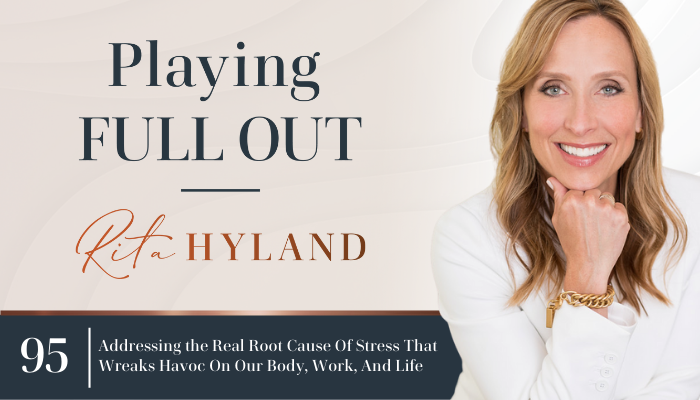
Addressing the Real Root Cause Of Stress That Wreaks Havoc On Our Body, Work, And Life

cause-of-stress

Listen to the full podcast episode to hear how to address the real root cause of stress:

There’s something extra special about waking up in the morning when you’re on vacation. I recently experienced it. It’s that elimination of incoming stress as you wrack your brain for things that need to be done in the hours ahead. Instead, in the absence of stress you wake up feeling at peace – your body relaxed and you feel energized and free.

What if you could feel like that every day, not just when you’re on vacation? Do you ever wonder if you were free from stress, who would you have the freedom to be? 

Too many people experience feeling stress-free only a few days out of the year. According to The American Institute of Stress, 33% of people report feeling extreme stress. 

77% of people experience stress that affects their physical health.

73% of people have stress that affects their mental health.

The numbers don’t lie about the havoc that stress wreaks. Three out of four of us are dealing with stress that is negatively impacting our life. That could be you as a leader, your employees, or your family members.

This stress prevents you from playing full out personally and professionally. Yet, too often we feel that stress simply comes with the territory. It’s a known “side-effect” of the life we lead. I want you to know that this doesn’t have to be the case. 

The topic of stress is nothing new, but the way that I want to approach solving it is. Rather than addressing the external causes and symptoms of stress, I want to address the real root cause of stress so that you can transform it. 

Managing your symptoms is only sustainable for so long and like anytime we only address symptoms, stress will continue to return if you aren’t addressing its source. I know.  For too long I unsuccessfully tried to control my external world in order to avoid stress. 

Instead of trying to control everything around us to keep stress at bay, we can learn how to self-regulate so that when we experience stress, we will have the tools to extract the root and transform it. Learning this technique along with two ways to self-regulate will allow you to stop the pattern of continually being triggered by the same situation, employee, worry, or family member, over and over again. 

So if you’re feeling the stress of doing a million things and feel like you are carrying a lot for many, tune in and take notes!

In this episode on addressing the real root cause of stress, I share:

  • How to uncover the real root cause of stress and go beyond working on the surface symptoms  
  • Two simple techniques to pull yourself out of a stress attack instantly
  • The liberating mindset shift to go from blaming external circumstances or other people for your stress so you can be freer than ever before 
  • Why it matters which nervous system we are operating from 
  • How to recognize your triggers and what to do once you observe them 
  • A 4-step approach to balancing your subconscious so it doesn’t take over your life

More Resources:

  • Tune into the previous episode, Becoming a Jumpseat Leader with Peter Docker
  • Learn more about the effects that stress can have on your body.
  • If you’d like to be notified of when new podcast episodes are released, you can do so here: Playing Full Out
  • Learn more about the Inside Out Method
  • Connect with Rita on LinkedIn.

Subscribe on Apple Podcasts for more tips, tools, and inspiration to leading the optimal vision of your life, love, and leadership. Remember, a half version of you is not enough. The world needs the fullest version of you at play.

Listen on Apple Podcasts

___

About Rita Hyland

With over 20 years of experience as an executive and leadership coach, Rita helps leaders — emerging and established — excel in corporate and entrepreneurial environments.

Rita believes if leaders were more clear about how transformation really works and more intentional about creating what they want, their impact, success, and influence in the world would be unstoppable.

Through her coaching programs, private coaching, and masterminds, Rita shows leaders how to win consistently and create the impact and legacy they desire.

Central to Rita’s work is the understanding that you will never outperform your current programming, no matter how strong your willpower.

When you learn to use Rita’s proprietary Neuroleadership Growth Code, a technology which uses the best of neuroscience and transformational psychology to hit the brain’s buttons for change, YOU become both the solution and the strategy.

Her mission is to end talented, hard-working, and self-aware leaders spending another day stuck in self-doubt or confusion and not contributing their brilliant work and talent the world so desperately needs.

https://www.ritahyland.com/wp-content/uploads/2022/04/RH-Podcast-Featured-Graphics-95.png 464 440 Candace Maree https://www.ritahyland.com/wp-content/uploads/2020/04/Rita-Hyland-1-line-blue-NOTAG-01.svg Candace Maree2022-04-21 05:00:392024-03-01 17:05:47Addressing the Real Root Cause Of Stress That Wreaks Havoc On Our Body, Work, And Life
Page 1 of 41234

Hi, I’m Rita!

I’ve guided individuals, leaders and teams over the last two decades through 1000’s of challenges —coaching them to build businesses and careers that thrive and lives they love.

Recent Posts

  • The Gifts I Found Walking the Inca TrailNovember 11, 2025 - 2:20 pm
  • Healing through love and trust
    What My “Batcat” Taught Me About Healing and HumanityOctober 13, 2025 - 6:45 pm
  • Rita reflects on nearly saying no to a Machu Picchu trip, sharing why waiting holds us back and encouraging readers to act on what they’ve been putting off.
    Why I Almost Missed Machu PicchuSeptember 30, 2025 - 4:39 pm
SUBSCRIBE ON ITUNES
  • About
  • Work With Me
  • Testimonials
  • Podcast
  • Blog
  • Contact

© 2024 Rita Hyland | PRIVACY

Scroll to top