Listen To My Latest Podcast Episode:

149: A 3-Question Practice To End Overthinking and Move Forward

Listen To My Latest Podcast Episode:149: A 3-Question Practice To End Overthinking and Move Forward

  • About
    • My Journey
  • Work With Me
    • 1 on 1 Coaching
    • Inside Out Method
  • Testimonials
  • Podcast
    • Media
  • Blog
  • Giving Back
  • Contact
  • Search
  • Menu Menu
  • LinkedIn

Tag Archive for: imposter syndrome

pre-mortem exercise

Mastering the Pre-Mortem: Boost Your Team’s Success and Your Personal Goals With This Simple Exercise
pre-mortem exercise

Listen to the full podcast episode to learn about the science-backed practice that has not only changed my life but also the lives of countless people over the last two decades. This is something you can’t ignore if you want to achieve that great goal you identified for this year and write your new future.


Planning is often seen as the cornerstone of success. Yet, even the most meticulously crafted plans can encounter unforeseen obstacles. So, how can we better prepare for these inevitable bumps in the road?

In this episode, I’ll share an exercise called the pre-mortem, which can help you flip the script and plan for potential pitfalls so you can avoid them altogether. Whether you’re leading a team of 100 — or just yourself —  this powerful exercise can dramatically increase your chances of success!

What is a Pre-Mortem?

Recently, I had the opportunity to speak to a group of internal strategists at a company. These strategists are crucial in driving their organization’s strategic goals, often juggling multiple stakeholders with varying priorities and skill sets. 

It can be a challenging environment, and they wanted to know if there was a way to establish ownership and commitment early on to boost their chances of success.

The answer was yes— the pre-mortem.

A pre-mortem is essentially the opposite of a post-mortem. In a medical setting, a post-mortem analyzes what caused a person to die. Similarly in a business setting a post-mortem looks at what has caused a project to fail after it has already failed. A pre-mortem involves imagining that the project has failed before it even begins and then identifying the reasons for this hypothetical failure. 

This proactive approach allows teams and individuals to foresee and address potential issues in advance, thereby improving the chances of success.

Implementing a Pre-Mortem in Team Settings

When leading a team or multiple groups with different priorities, conducting a pre-mortem can quickly establish ownership and commitment among team members. Here’s a couple of effective methods to implement it:

The Checklist Method: If you have an experienced team, you likely already know common reasons for project failures, and you can create a checklist from them. Before starting any new project, review this comprehensive checklist with your team and allow each member to assess potential problems against known issues.

The Brainstorming Method: For a more organic approach, begin by informing team members that the project has hypothetically failed. Give everyone a few minutes to write down all possible reasons for this failure. This method can bring unnoticed but critical issues to light because it encourages fresh perspectives. This leads to a list of potential pitfalls and allows you to address them upfront, strengthening your project plan from the get-go.

For example, someone in operations might highlight technical limitations, while someone in sales might point out market risks. By foreseeing these issues early, you can plan around them, enhancing the project’s chances of success.

Applying the Pre-Mortem to Personal Goals

The beauty of the pre-mortem exercise is that it’s not limited to team projects; it’s also beneficial for personal goal setting. Here’s how you can use it for your own aspirations:

Career Transition: Imagine you have a goal to transition to a more fulfilling career by the end of the year. Instead of starting with enthusiasm and risking a loss of momentum, presuppose that you’ve failed to make the transition. Ask yourself why. Common reasons might include doubting your capabilities, not reaching out for support, or letting other priorities interfere.

By identifying these potential pitfalls at the outset, you can create a stronger, more realistic plan to overcome them. For instance, if imposter syndrome is a concern, you might seek mentorship or professional development opportunities to build your confidence.

Enjoying Your Summer: If your goal is to have a memorable summer, imagine it’s the end of summer, and you feel unfulfilled. Why? Perhaps you didn’t plan activities, prioritize family time, or make spontaneous decisions. By identifying these regrets and the reasons for them in advance, you can proactively plan and schedule activities to ensure a fun and fulfilling summer.

Why use a Pre-Mortem?

With a pre-mortem, you aren’t left to deal with the aftermath of failure; instead, you proactively anticipate and address obstacles. This exercise leads to multiple benefits:

  • Improves Efficiency and Prioritization: By identifying potential problems early, the team (and you) can address them before they become actual issues, saving time and resources.
  • Enhances Focus and Commitment: Team members feel valued for their input and are more committed to the project’s success.
  • Encourages Honest Communication: Team members are more likely to voice concerns and identify issues that might otherwise go unmentioned.
  • Reduces Post-Launch Surprises: Spotting and addressing problems before they arise minimizes last-minute chaos and enhances overall project stability.

Try a Pre-Mortem on Your Next Project!

Choose a project or goal you have right now, conduct a pre-mortem, and see how it transforms your planning and execution. Here’s some tips to help you get started:

  1. Start Small: Practice the pre-mortem exercise with smaller projects or goals to get comfortable with the process.
  2. Be Honest: Encourage honesty and openness during the brainstorming session to uncover all potential issues.
  3. Use the Findings: Act on the identified issues by incorporating solutions into your project plan, ensuring they are addressed from the start.

The pre-mortem exercise is a powerful tool that can significantly improve your chances of success in both professional and personal pursuits.

By anticipating failure and addressing potential issues early, you set yourself and your team up for success. 

Whether you’re leading a large project or pursuing a personal goal, give the pre-mortem a try. You’ll find it transforms the way you plan and execute, helping you avoid pitfalls and achieve your aspirations with greater ease and confidence.

Don’t forget to share your experiences and results—I can’t wait to see what you create!

In this episode:

  • Understand the importance of “failure planning” to help create realistic plans and avoid common pitfalls.
  • Learn the ways to address potential issues before they arise, increasing the likelihood of project success.
  • Develop and encourage team members to voice their concerns and take ownership of fostering a collaborative and committed environment.

Resources and related episodes:

  • Tune in to the previous episode, Key Strategies To Overcome Rejection So You Remain Unstoppable
  • If you’d like to be notified of when new podcast episodes are released, you can do so here: Playing Full Out
  • Learn more about the Inside Out Method
  • Connect with Rita on LinkedIn


Subscribe on Apple Podcasts for more tips, tools, and inspiration to lead the optimal vision of your life, love, and leadership. Remember, a half version of you is not enough. The world needs the fullest version of you at play.

Listen on Apple Podcasts

___

About Rita Hyland

With over 20 years of experience as an executive and leadership coach, Rita helps leaders — emerging and established — excel in corporate and entrepreneurial environments.

Rita believes if leaders were more clear about how transformation really works and more intentional about creating what they want, their impact, success, and influence in the world would be unstoppable.

Through her coaching programs, private coaching, and masterminds, Rita shows leaders how to win consistently and create the impact and legacy they desire.

Central to Rita’s work is the understanding that you will never outperform your current programming, no matter how strong your willpower.

When you learn to use Rita’s proprietary Inside Out Method, a technology that uses the best of neuroscience and transformational psychology to hit the brain’s buttons for change, YOU become both the solution and the strategy.

Her mission is to end talented, hard-working, and self-aware leaders spending another day stuck in self-doubt or confusion and not contributing their brilliant work and talent the world so desperately needs.

https://www.ritahyland.com/wp-content/uploads/2024/06/pre-mortem.png 464 440 Joyce Polintan https://www.ritahyland.com/wp-content/uploads/2020/04/Rita-Hyland-1-line-blue-NOTAG-01.svg Joyce Polintan2024-06-27 05:00:042024-09-12 13:42:03Mastering the Pre-Mortem: Boost Your Team’s Success and Your Personal Goals With This Simple Exercise
self-worth

What Working Hard May Tell You About Your Self-Worth

self-worth

Listen to the full podcast episode to learn about the science-backed practice that has not only changed my life but also the lives of countless people over the last two decades. This is something you can’t ignore if you want to achieve that great goal you identified for this year and write your new future.

I’m going in deeper than I have in the past on a topic I haven’t really covered before—self-worth. 

In part, it has to do with a conversation from a previous Playing Full Out podcast episode devoted to why we overwork. It’s called How to Work Less Without the Worry. 

I heard from many of you who had more questions and said you really resonated with  the topic. That you’ve accomplished a lot in so many ways, but continue to struggle with being able to stop working so hard or to slow down and enjoy what you’ve already created and achieved. That no matter what you have accomplished it never feels like it’s enough which makes it hard to ever shake the push to work harder, accomplish, and hustle more.

One business owner shared that he thought when he reached a certain level that he’d finally feel satisfied, but that something is still missing. 

He said he’d give anything to be able to enjoy more of his accomplishments — but that he always seems to be chasing something more.

I completely understand. It’s something I learned about myself for the first time a long time ago that explained so much of my dissatisfaction and my compulsion to hustle—even after I had achieved something that I thought would give me the feeling that I was missing. 

It had everything to do with a belief in my self-worth, which is the topic of this episode.

Many years ago, I walked into the office of an individual who I was hoping would help me identify a more satisfying career.  I left with what I thought was an unusual assignment. My homework was to embrace the belief that I am worthy of unconditional love. 

The woman said, “Understand that you don’t have to accomplish another thing in order to be worthy.” 

That felt incredibly uncomfortable. And while it was nice, I didn’t see what that had to do with me identifying a fulfilling career. What I hadn’t seen was that most of my life, I believed that if I only accomplished and achieved enough, then I would be enough. I would feel worthy. 

I hadn’t seen that I was always being driven by this deep belief that my worth was directly correlated to my accomplishments. 

It was this belief that kept me hustling and working hard to achieve more. Because I figured if I pleased enough people, if I accumulated the things that most considered representations of success and if I got enough validation and recognition, that I’d finally feel those feelings of fulfillment that I was yearning for. 

I hadn’t seen that this was at the root of what was driving me to spend long hours working 3 jobs, working out constantly, perfecting my work, pleasing my bosses along with my family, and friends — and never feeling real satisfaction. 

But these beliefs didn’t then—and still don’t—foster fulfillment because they aren’t true at all. 

These beliefs are based on a lie. The lie that we have to achieve and work hard and do more in order to be worthy. 

It made sense why it was so uncomfortable for me to slow down and enjoy what was in front of me.

Since then I’ve spent a lot of my professional life with incredibly successful people on the outside. But whether they’ve had career or financial success—it never felt like it was enough. 

So they did the only thing they knew—the only thing they’d ever been taught—they worked harder.

Hear me out. No one has ever come to me and said they have a self-worth problem. 

We have relationship problems, business problems, health problems, and career problems. 

Self-worth is not one of them. 

But Jamie Kern Lima in her book, Worthy, shares the numbers struggling with worthiness issues and they might surprise you.

  • 90% of women struggle with not feeling enough. 
  • 73% of female executives battle with imposter syndrome. 

And before you think it’s just a female issue, note that the numbers for men are almost the same.

  • 70% of men feel inadequate. 

These numbers are staggering as well as sad because not feeling worthy prevents us from sharing our brilliance. And we never feel truly satisfied. 

How do you know whether self-worth may be at the root of your current problem?  If you struggle with: 

  • walking into a meeting 
  • asking for what you want 
  • speaking what you think
  • promoting yourself
  • stagnating on accomplishing an important milestone or
  • holding a boundary to work less

…these are all signs that you may need to start with looking at the faulty belief of “I am not worthy enough.”

We often believe we need more confidence, or new tactics or techniques, but—self-confidence is an external experience, while self-worth is an internal matter. 

Trying to feel fulfilled by accomplishing more, will simply not work. It’s like threading a needle while you’re wearing boxing gloves. It’s absolutely impossible. 

While achievement can make you feel a lot of things—empowered, more self-confident, stronger—it will never make you feel worthy.

I am sure you—just as I didn’t—don’t think there’s a self-worth issue.

It had never occurred to me that my feelings of not believing I was enough could resolve my  external problems of working too hard, not liking the career I was pursuing or my financial situation — but it did.

If you’re in a career that is wonderful or looks good by external measures, but… you don’t feel worthy of having it, then you’re not going to show up at your highest levels of capacity or ability or talent. 

We can achieve all the things that make us look like a success, but if we don’t have the feeling or identity of someone who is worthy of that success—exactly as we are, without doing another thing or without anything else—then we can achieve all those things, but we’re never really going to feel fulfilled.

I’ve learned that people can gain more self-confidence and move through their failures, have higher performance, achieve big milestones, but if they haven’t learned how to increase their belief that they are worthy, they’re never really going to feel the satisfaction and fulfillment they are yearning for. 

Many of us are realizing that despite having accomplished all the things that we thought would make us feel fulfilled or satisfied, that we’re still missing the feeling of internal satisfaction. 

The biggest costs to those in a position of leadership when they don’t feel worthy enough or are dealing with imposter syndrome are how it hinders decision making abilities, leads to self-sabotage, and keeps us individuals stuck in hustle mode. 

Our cultural conditioning trained us that we must hustle for our worth.  

But the truth is we’ve been worthy since the day we were born.

Understand that just by existing—no matter what socioeconomic level, title, or what you’ve accomplished—You Are Worthy. 

The reality is that I still work on cultivating my own self-worth everyday. I can see when I’m stagnating on important decisions or not showing up fully. 

But as I have thoughts that I’m supposed to get approval from others or when I’m not accepting a challenge—it’s then that I take a breath and use the very tools I encourage my clients to use. 

When you find yourself not feeling worthy, do this exercise

Notice those times when you’re stagnating, overthinking, stalling, or maybe even changing who you are to get approval.

Then write out what I call a Worthy List. 

Start by writing the things you’re not doing, or feeling, or experiencing. And then in front of it, write “I am worthy to.” 

For example:

    • I am worthy to rest.
    • I am worthy to take a vacation.
    • I am worthy to make a career change.
    • I am worthy to not take on that project.
    • I am worthy to love myself exactly as I am.
    • I am worthy to say “no thank you” to the invitation or 
    • I am worthy to say “no more” to the work I don’t like

When you feel worthy of the role you are in or what you have, it doesn’t mean you stop pursuing your goals or dreams—it means you don’t pursue them with the belief that they’re going to make you feel fulfilled. 

What you want is when you do achieve these things, you’re able to enjoy them. And if you don’t achieve them, you feel worthy regardless! 

That is the “there” so many high-achievers are pursuing. It’s the feeling of internal peace, satisfaction and fulfillment regardless of what level of success we’ve hit or what anyone else thinks.

The great news is that you can learn to feel worthy.  

And when you learn to feel that you are enough, it will allow you to stop working so hard and hustling to achieve because you’ll realize it already exists within you. You’ve had it all along.

In this episode, I share:

  • How not feeling worthy negatively can affect your business, career, health, and relationships
  • Signs to spot feelings of unworthiness 
  • A quick exercise in the journey of learning to feel worthy

Resources and related episodes:

  • Tune in to the previous episode, The One Strategy to Level Up Your Problem Solving
  • Listen to episode 126: How to Overcome Your Resistance to Work Less
  • If you’d like to be notified of when new podcast episodes are released, you can do so here: Playing Full Out
  • Learn more about the Inside Out Method
  • Connect with Rita on LinkedIn

Subscribe on Apple Podcasts for more tips, tools, and inspiration to lead the optimal vision of your life, love, and leadership. Remember, a half version of you is not enough. The world needs the fullest version of you at play.

Listen on Apple Podcasts

___

About Rita Hyland

With over 20 years of experience as an executive and leadership coach, Rita helps leaders — emerging and established — excel in corporate and entrepreneurial environments.

Rita believes if leaders were more clear about how transformation really works and more intentional about creating what they want, their impact, success, and influence in the world would be unstoppable.

Through her coaching programs, private coaching, and masterminds, Rita shows leaders how to win consistently and create the impact and legacy they desire.

Central to Rita’s work is the understanding that you will never outperform your current programming, no matter how strong your willpower.

When you learn to use Rita’s proprietary Neuroleadership Growth Code, a technology that uses the best of neuroscience and transformational psychology to hit the brain’s buttons for change, YOU become both the solution and the strategy.

Her mission is to end talented, hard-working, and self-aware leaders spending another day stuck in self-doubt or confusion and not contributing their brilliant work and talent the world so desperately needs.
https://www.ritahyland.com/wp-content/uploads/2024/03/self-worth-1.png 464 440 Joyce Polintan https://www.ritahyland.com/wp-content/uploads/2020/04/Rita-Hyland-1-line-blue-NOTAG-01.svg Joyce Polintan2024-03-21 05:00:422024-03-22 15:31:34What Working Hard May Tell You About Your Self-Worth
mindset management

Your Mindset Management Practice For Higher Performance

mindset management

Listen to the full podcast episode to learn about the science-backed practice that has not only changed my life but also the lives of countless people over the last two decades. This is something you can’t ignore if you want to achieve that great goal you identified for this year and write your new future.

Many of us place a lot of pressure on ourselves to perform extraordinarily every day.  But there’s something important we’re missing.  We don’t prioritize training our mindset to perform at those extraordinary levels.

When we know that how we think determines how we react to things, it becomes our #1 priority to manage our thoughts.  Not doing so is like setting out to build a house with a sand shovel.  We wouldn’t do it.

We expect to experience worry-free, confident, high-performing days but we’re either unaware of how to leverage our mindset or we lack the discipline to manage our mindset for the high-performance we expect. 

As a result, too often our sloppy, unmanaged thoughts leave us feeling… stressed that we can’t get it all done, doubting we have what it takes to deliver, critical and short with others, exhausted by what we see as limited progress and second-guessing we will see our existing success to fruition. 

Recently my family and I watched several Netflix documentaries about seasoned sports players and teams. They highlighted the strengths and vulnerabilities of athletes in a variety of sports—golf, basketball, football, etc. I am always fascinated by the psychological performance and rituals that these top-performing athletes practice to perform at such high levels.

They know that how we think about things drives our behavior. That performing extraordinarily begins with having a high-performance mindset. So they place a premium on their mindset management. 

It got me thinking —  why is it that those of us in other industries don’t place that same level of attention on our mindset management? Why do leaders in other industries not apply that same level of consistency and discipline to their mindsets that athletes do?  

Messy, unbridled mindsets too often leave us feeling… 

  • Stressed over endless to-do lists
  • Wondering if we have what it takes to achieve our goals
  • Exhausted and burnt-out because the pressure is high and progress is slow
  • Unfocused because we’re trying to do too much at a high level

These feelings result in average performance — at best!

So what can be done to develop a high-performance mindset?  

Here’s a favorite short mindset management practice that you can use daily to set yourself up for success. The best part is that it can be done in less than five minutes. 

Each prompt has a specific benefit backed by brain science to help you improve your well-being and performance. 

It’s what high-performing athletes and modern day leaders use to show up and perform their best every day when it matters most.

Managing our mind isn’t something we can only employ some of the time. Everyday we face unexpected challenges and things outside of our control.  This is when being able to manage our thoughts becomes invaluable.

Here’s how to do your 5-minute Morning Mindset Management Practice.

Ask and answer each of the following five prompts.

  1. What are 3 things I’m grateful for? Sitting in the answer to this question directly affects the hypothalamus. The hypothalamus is a part of the brain that influences sleep, hunger, and stress. When brains were studied while a subject was experiencing gratitude, they found the subject’s hypothalamus was being influenced in real-time. When you are focusing on what you’re grateful for, you create new neural pathways for expansion and advancement.
  2. What 3 things would make today great? From a scientific perspective, this activates your brain’s Reticular Activating System or RAS. What happens is when you direct your RAS for what to look for, it sets out to find it — without you even being aware of it. You’ve likely experienced when you’ve decided to buy a certain car and suddenly you see the car is everywhere.  There was a famous study in the NBA on basketball players who weren’t hitting their free throw shots. The underperforming athletes were broken into three groups. The first group did not practice their free throws for a week. A second group was told to practice exactly 100 free throw shots every day. And a third group was told not to physically practice but to imagine perfect free throw shots every day. The third group, which only imagined hitting shots perfectly,  improved their performance the most. The brain receives 11 million bits of information per second, but it can only process 33 bits per second. The 33 it processes are the 33 it is told to look for.  It seeks to fill your order. 
  3. Who am I going to be today? Think: Who do I need to be in order to perform as I want? We typically make to-do lists. But the doing is directly influenced by who we’re showing up as. Your way of being informs the actions you will take so you can perform at the level you want. So what qualities are you going to bring to your day? It’s the Be — Do — Have model of performance that high-performers use. Many of us were taught that doing is where performance comes from, but in reality it’s your identity which is a reflection of your thoughts and ways of being that directs and does the heavy lifting. 
  4. What am I open to receiving? Too often we don’t realize that we really are not open to accepting what it is we say we want. Remember change is uncertain and that can be uncomfortable to our mind.  By answering this prompt, you prepare your mindset to notice and accept the opportunities before you. 
  5. What am I going to give? Maintaining the flow between giving and receiving is critical. Living a purpose-driven life is important to us all. We all want to matter. By clarifying what you will contribute, you align yourself with your purpose, passion and proficiency. In turn, you make a difference.

What happens when you learn to manage your mindset? You will…

  • Have the endurance necessary for big challenges and initiatives
  • Be able to navigate unexpected challenges 
  • Improve your ability to handle criticism which you will definitely encounter as a result of being in the arena 
  • Executing tasks easier because you’re not dealing with limiting thoughts
  • Focus on the most important things 
  • Managing problems and know when to let of anything that’s out of your control

High performance begins with self-awareness.

Our feelings and actions are directly impacted by our thoughts. Your mindset management practice is too important to leave to chance! It drives everything you do.

Don’t spend another day putting pressure on yourself to perform extraordinarily without providing yourself with the mindset that sets you up for success. 

In this episode, I share:

  • What the sports industry and high-achieving athletes can teach us about mindset management and performance
  • What’s keeping us from performing at the levels we think we “should” be able to
  • A 5-minute morning mindset management practice every leader can use to see immediate improvement in well-being and performance 

Resources and related episodes:

  • Tune in to the previous episode, Feel Your Feelings So They Don’t Run You
  • Listen to episode 114: How to Eliminate the Pressure so That You Can Enhance Your Career Anytime You Want
  • If you’d like to be notified of when new podcast episodes are released, you can do so here: Playing Full Out
  • Learn more about the Inside Out Method
  • Connect with Rita on LinkedIn


Subscribe on Apple Podcasts for more tips, tools, and inspiration to lead the optimal vision of your life, love, and leadership. Remember, a half version of you is not enough. The world needs the fullest version of you at play.

Listen on Apple Podcasts

___

About Rita Hyland

With over 20 years of experience as an executive and leadership coach, Rita helps leaders — emerging and established — excel in corporate and entrepreneurial environments.

Rita believes if leaders were more clear about how transformation really works and more intentional about creating what they want, their impact, success, and influence in the world would be unstoppable.

Through her coaching programs, private coaching, and masterminds, Rita shows leaders how to win consistently and create the impact and legacy they desire.

Central to Rita’s work is the understanding that you will never outperform your current programming, no matter how strong your willpower.

When you learn to use Rita’s proprietary Neuroleadership Growth Code, a technology that uses the best of neuroscience and transformational psychology to hit the brain’s buttons for change, YOU become both the solution and the strategy.

Her mission is to end talented, hard-working, and self-aware leaders spending another day stuck in self-doubt or confusion and not contributing their brilliant work and talent the world so desperately needs.
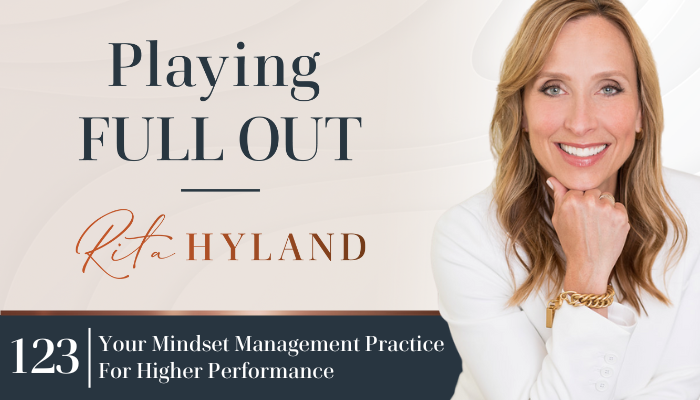
https://www.ritahyland.com/wp-content/uploads/2023/10/RH-Podcast-Featured-Graphics-123.png 464 440 Joyce Polintan https://www.ritahyland.com/wp-content/uploads/2020/04/Rita-Hyland-1-line-blue-NOTAG-01.svg Joyce Polintan2023-10-05 05:00:512024-03-01 16:46:46Your Mindset Management Practice For Higher Performance

Hi, I’m Rita!

I’ve guided individuals, leaders and teams over the last two decades through 1000’s of challenges —coaching them to build businesses and careers that thrive and lives they love.

Recent Posts

  • The Gifts I Found Walking the Inca TrailNovember 11, 2025 - 2:20 pm
  • Healing through love and trust
    What My “Batcat” Taught Me About Healing and HumanityOctober 13, 2025 - 6:45 pm
  • Rita reflects on nearly saying no to a Machu Picchu trip, sharing why waiting holds us back and encouraging readers to act on what they’ve been putting off.
    Why I Almost Missed Machu PicchuSeptember 30, 2025 - 4:39 pm
SUBSCRIBE ON ITUNES
  • About
  • Work With Me
  • Testimonials
  • Podcast
  • Blog
  • Contact

© 2024 Rita Hyland | PRIVACY

Scroll to top